
He Came Down From Heaven

Part 3 of a 4 Part Advent Series
To get you in the mood for this post… enjoy this (now 14-year old!) rendition of my favorite song ever written: Hark! the Herald Angels Sing. Video recorded live with my friends in a house we bought just before the 2008 market crash and sold in 2015 basically breaking even. Glory to the newborn King!
This post is pure stream of consciousness this morning, Wednesday, December 17. Later today I’ll finish the first draft of my sermon manuscript for this weekend. But this morning is the wild winter west. I’m thinking about the third section of the defining statement of our Christian faith, the Nicene Creed. It reads:
For us and for our salvation he came down from heaven,
was incarnate from the Holy Spirit and the Virgin Mary
and was made man.
For our sake he was crucified under Pontius Pilate;
he suffered death and was buried.
On the third day he rose again
in accordance with the Scriptures;
he ascended into heaven
and is seated at the right hand of the Father.
He will come again in glory to judge the living and the dead,
and his kingdom will have no end.
What a line: For us and for our salvation He came down from heaven.
That line became the thesis of Athanasius’ timeless masterpiece of Christian thought: On the Incarnation. It is one of my all-time favorite books, and one of the few books I read every year during Advent season. It’s always amazed me that we have Amazon-easy-access to a book about Jesus written by a brother in Christ who lived 1,735 years ago.
Fun question: How many 1700+ year old books do you have on your shelf (other than the Bible)? My guess is not many.
I did a quick google. Exact numbers are debatable, but the point stands: About 130 million books have ever been published. Nearly all of them are recent. Roughly 100 million were written in the last century alone. Of the remaining 30 million, most appeared in the last 200 years, and most of those are already out of print. Only a few hundred thousand books still in circulation were written more than 300 years ago. Only a few thousand reach back a millennium. By the time we look 1,700 years into the past for complete books still available to read today, we’re talking about maybe 200–300.
And I’m reading one of those books this Advent… which is so wild to me!
About five years before he wrote it, Athanasius was quietly present at the Council of Nicaea (325 AD). He watched patiently as Arius defended his heretical view that Jesus was less God than God the Father. He listened attentively as the bishops responded with what would be considered orthodoxy by the unanimous witness of the Spirit-driven Body of Christ until Christ returns. He could not cast his vote as a mere attending deacon, but he bore witness to the gospel: Father, Son, and Spirit are one God in three co-equal Persons, and the eternal Son Jesus Christ came down to us from heaven, for us and for our salvation
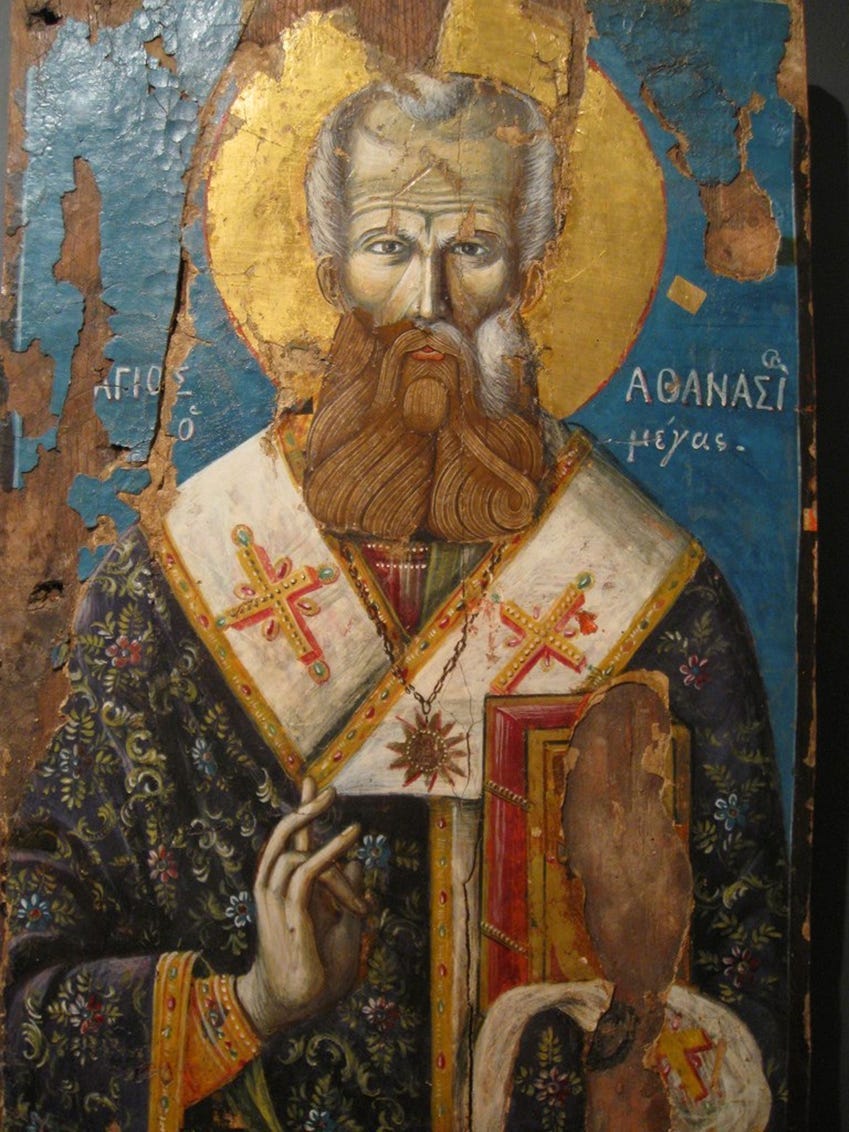
Athanasius would go on to become one of the most pivotal Christian leaders in history, earning the nickname “Father of Orthodoxy” for fearlessly defending Christ’s full divinity against Arianism. Yep, you heard that right: the Arian heresy rose again. “Heresy” is just a word that meant “different school.” Like… not Jesus’ school. Anyone is free to attend whatever school they want. As long as we’re not pretending or gaslighting fellow students and teachers.
Imagine walking onto your high school campus… let’s call it Bayside High for the three fellow Saved By the Bell fans reading this (where my people at?!). With fannypack and sweaty palms equipped, you launch a calculated campaign to convince your fellow students and academic staff that the Bayside High mascot, the Tiger, is actually a Bulldog (which just so happens to be the same mascot as cross-town rivals Valley High Bulldogs, but who’s counting gods… er mascots). You screech, “Guys! Look. I’ve been studying animal phylum philology. We’ve got our Tiger all wrong! See that elongated snout? It screams ‘canine’, not ‘feline.’ And check out these matching bulldog paw and ear samples I have. Surely you’ve seen bulldogs before. How many tigers have you seen?? Never mind the confusing stripes. It all points in one direction: We have a bulldog for a mascot!”
You’d get a fast pass to the counselors office.
Why? Because everyone at Bayside High knows the bulldog belongs at Valley High. So the bulldog heresy is precisely that… because it belongs to a different school.
And that distinction makes all the difference. Why? Because a different school will shape different students. And when the headmaster and main subject of this school is Jesus, then the difference isn’t just academic. It’s whole-person-formative… mind, body, and soul.
Athanasius knew this. He knew the school of the God-Man Jesus (i.e. The Church) was worth fighting for because it is the only school on earth that’s organized and operated by the personal Presence of the God who for us and for our salvation came down to us from heaven. It’s the only school that will not fail in shaping humans into God’s faithful family that He sees us becoming. It’s the only school of faith, hope, and love, all three.
Next week is the final post in this series. It’ll be all about the Holy Spirit and the holy Catholic church and why it’s high time “catholic” not longer be a creepy word for nondenom evangelicals.
For now, I leave you with one point to ponder from this week’s portion of the creed:
was incarnate from the Holy Spirit and the Virgin Mary
and was made man.
For our sake he was crucified under Pontius Pilate;
he suffered death and was buried.
Notice the two other humans in this creed about Jesus:
The Virgin Mary. Poor. Jewish. A teenage girl. Living under the violent boot of the Roman Empire. About as voiceless and low-status as a person could be in her world. The kind of person empires overlook and respectable society prefers not to hear from. People like Mary, then and now, are dismissed as naïve, inconvenient, or “ideological” when it dares to speak (as in her Magnificat, Luke 1:46–55).
Pontius Pilate. Wealthy. Roman. Male. Educated. Politically connected. Installed as governor of Judea by Emperor Tiberius Caesar himself. A man at the peak of social power, siloed within empire and fluent in the currency of status and control. A prototype of the kind of leadership Western civilization would come to admire and reward, especially when it promises order and dominance.
Have you ever wondered why Mary’s and Pilate’s names appear in the defining statement of Christian faith? Of course, there is the historical reason: they really existed and did what the Gospel accounts say they did. But may I also suggest a theological reason for their naming in the creed? (After all, this creed is primarily to be communally prayed as a theological confession of faith!)
I submit that Mary and Pilate are named to contrast God’s kingdom vision of true power with the false power of what many biblical theologians call “empire,” what the Apostle Paul calls “principalities and powers,” and what the Apostle John calls, simply, “the world” (1 John 4:5).
God’s vision of power = Mary. Weak in the world’s eyes, but strong-of-soul enough to confess back to God: “I am your servant; may your word to me be fulfilled.” Mary’s kind of power is the kind that saves the world and moves the hand and heart of God. Pilate’s power can’t do that. Pilate thought he could. When Jesus remained silent, Pilate filled the air with noise, “Don’t you realize I have the power to either free you or crucify you?!”
But he didn’t.
The creed prioritizes Mary’s name before Pilate’s to show us what kind of power truly wins the world… even today.
It won’t be Pilate-style culture warring or political posturing or substack screeds launched into the digital atmosphere (I feel this temptation myself all the time.)
It will be Mary’s voiceless yes to the incoming power of the Most High.
So I humbly share my personal prayer this third week of Advent:
Lord Jesus, Son of David, have mercy on me, a sinner.
As it was to the Blessed Virgin Mary, Mother of God,
May your word to me be fulfilled also.
Make me your servant, in my posting as in my praying,
In my parenting as in my preaching.
And as Athanasius set his heart ablaze for your school alone,
May you also keep mine lit with love for you,
And from that flame may I burn with like love
For friend, and stranger, and theological enemy the same.
In the name of the Father, and of the Son,
And of the Holy Spirit.
Amen